Frosty Mistletoe
Suzsanna Bird

Mistletoe magic: Facts you might not know about this festive icon!

Mistletoe - it's practically woven into the fabric of the festive season. It's hung in doorways, referenced in carols, and generally steeped in tradition. But beyond the festive romance, this familiar plant has a surprising biology and an important part to play in nature. Let's take a closer look at mistletoe and why it deserves our attention long after the decs come down!

What exactly is mistletoe?

Interestingly, mistletoe isn't just one plant, but a group of species in the order Santalales. These plants are hemiparasites, meaning they photosynthesise to survive but also rely on other trees and shrubs for water and minerals.

In the UK, the species we're most familiar with is European mistletow (Viscum album). This is the only mistletoe native to the British Isles and it grows attached to host trees like apple, lime, poplar, and hawthorn, using a specialised structure called a haustorium to tap into the host's tissues. Sounds kind of bizarre yet brilliant, right?!

How does misletoe grow?

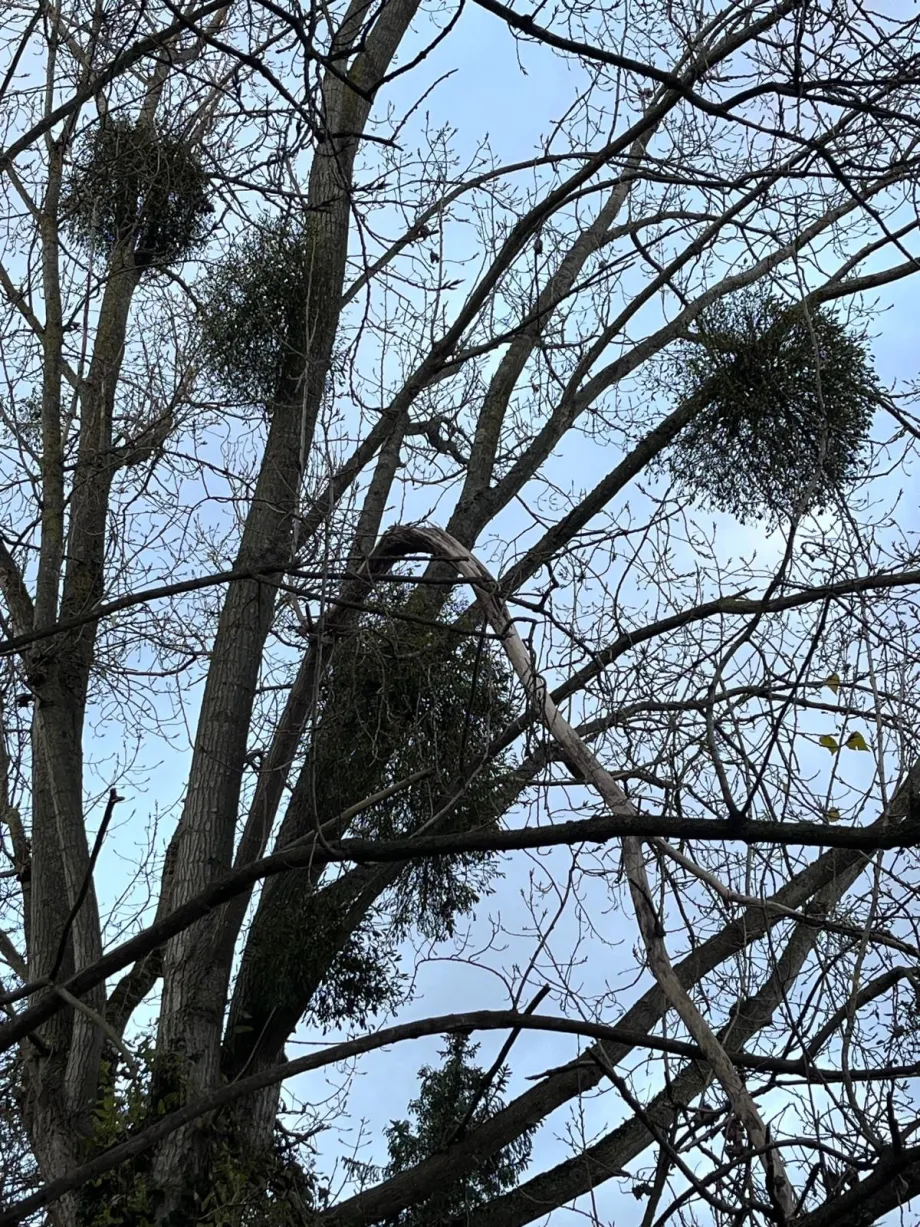
As we mentioned, mistletoe species grow on a wide range of host trees - some of which experience reduced growth, stunting, and loss of infested outer branches as a result. In fact, a heavy 'infestation' of mistletoe may sometimes kill the host plant. At this time of year, when the trees have lost their leaves, you can easily spot mistletoe in the canopy. You'll tend to notice what look like abandoned bird nests at first - large, round ball shapes in the trees. On further inspection, you'll see the classic mistletoe leaves and those iconic berries.

But how does this process happen in the first place? How does mistletoe spread? Well, it cleverly offers up its berries to birds. The seeds are coated in a sticky goo, which compels the birds to wipe their beaks on the next tree - in turn, a seed or two is left behind, stuck in place by the goo! A mistletoe seed germinates on the branch of its host tree or shrub, and in the early stages is completely independent from the host. The germinated seed has two or four embryos, each producing a hypocotyl. This then grows towards the bark of the host plant and forms mistletoe in a clump. The hypocotyl then penetrates the bark - a process which can take a year or longer - while relying on its own photosynthesis in the meantime. Once the host's conductive tissue is reached, the mistletoe can rely on the host for water and nutrients.

Mistletoe in the trees

Keystone species for wildlife

Because of its hemiparasitic traits and the fact that the berries are technically poisonous for humans, you might think that perhaps this plant is more suited to Halloween than Christmas. But mistletoe is important to a huge range of wild species, providing an important food source for birds at a time when resources are scarce. In fact, areas where mistletoe has been cleared show a significant decrease in the populations of birds and other species.

Mistle thrush and migratory blackcaps, in particular, rely on its berries, while the mistletoe marble moth relies on it for its life cycle.

Because of its far-reaching impact on the species around it, mistletoe is often described as a keystone species - one that has a disproportionately large effect on how an ecosystem functions.
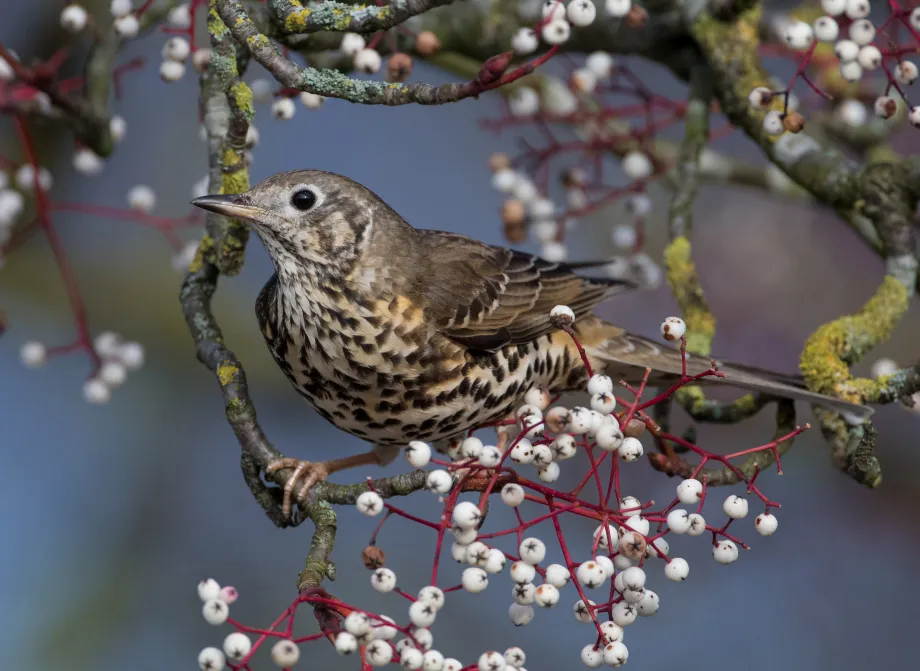
Mistle Thrush. ©️ Donald Sutherland

The history of mistletoe

As well as its natural significance, mistletoe has a rich history in many cultures. In some Pagan religions, the white berries were regarded as symbols of male fertility, while in Roman mythology, mistletoe was used by the hero Aeneas to reach the underworld. Roman writers have also described its use in cermonies linked to peace and reconciliation. Historically, mistletoe has been used in medicine for the treatment of arthritis, high blood pressure, epilepsy, and infertility. 

It wasn't until the advent of the Christian era that mistletoe became the kissing plant we know it as today! By the eighteenth century, it had become incorporated into Christmas celebrations around the world. The custom of kissing under the mistletoe was apparently popular amongst domestic servants, eventually becoming a festive tradition recognised around the world. As the story went, a man would be allowed to kiss any woman standing underneath the mistletoe - else bad luck would befall the woman who refused! We're not sure how we feel about that one, so we'll stick to celebrating mistletoe for the part it plays in our ecosystems...

So, this festive season, have look out in the branches of trees and see if you can spot the mistletoe growing - once you see them you will be spotting them all the time!
 

More winter wildlife blogs

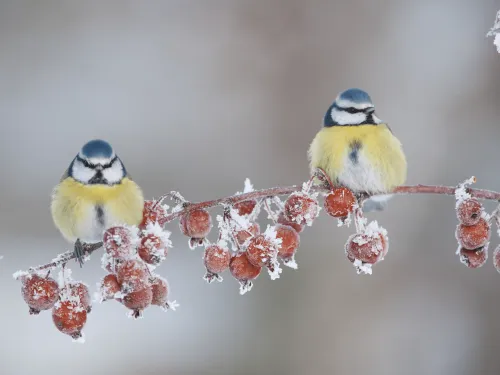
Two blue tits sitting on a branch of red berries covered in frost.
©️ Mark Hamblin/2020VISION

Create a wilder garden this winter

Blog

Wilder Gardens Officer, Ellen Tout, talks about her favourite parts of the winter garden and what you can do to make your space a sanctuary for wildlife.

A windswept tree against a misty sky with the sun peeking through.
©️ Paul Hobson

Finding light in the dark: How to connect to nature in winter

Blog

As winter takes hold, and you repeatedly find yourself commenting on how dark it is at 5pm, don’t despair. The colder months give us some excellent opportunities to connect with nature. Here are our top five tips for connecting with nature this winter…

Seven Wildlife Spectacles to See This Winter in Kent

Blog

Now winter has drawn in, seeking out wildlife spectacles may seem strange. However, nature does not take a hiatus during the colder months, and the winter landscape is teeming with remarkable displays of wildlife.