About the reserve
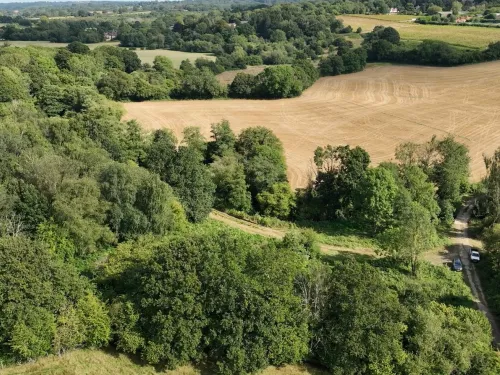
Ironhurst Valley takes its name from the area's ironworking heritage, its landscape character, and our long-term ambition for the site: one connected, thriving reserve for the benefit of nature and community. It is formed from two former farms – Furnace Farm which was acquired in 2024, and Hoathly Farm which was acquired in 2025. Together, the two farms form a 142-hectare site at the heart of one of Kent Wildlife Trust's most ambitious wilding and landscape recovery projects, restoring habitat after decades of intensive agriculture and creating a near-continuous wildlife corridor stretching across the Kent–Sussex border, from Scotney Castle to the East and Wadhurst Park to the Southwest.
The River Teise runs through the valley, still following many of its original meanders. Restoring the surrounding landscape is helping to recreate a grass and woodland complex along the valley bottom, improving water quality, reducing run-off, and providing natural flood prevention for the wider area.
Six Longhorn cattle have been introduced to begin conservation grazing across the site, a proven method for restoring and maintaining biodiversity across grassland, woodland and heathland. Longhorns were chosen for their hardiness, good temperament and adaptability across varying habitats and weather conditions. Beef Shorthorn cattle, another native and resilient breed, will join them in due course, helping to demonstrate how conservation grazing can deliver nature recovery on former arable land.
As the land regenerates, we hope to see the return of species that have been pushed to the margins by decades of intensive farming, among them yellowhammer, nightingale, turtle dove and dormouse.
A landscape shaped by history
Furnace Farm takes its name from the area's ironworking past, sitting near the historic Gloucester Furnace, before later becoming part of Kent's agricultural and hop-growing landscape, centred on its 16th-century farmhouse. Hoathly Farm has a similarly rich heritage, with a 17th-century farmhouse and records linking it to the historic Hoathly Manor system; more recently it was managed as a mixed farm of arable land, pasture and ancient woodland.
Restoration is planned on Furnace Farm's hopper huts and cook house, structures that hold deep significance for local communities, supported by the Farming in Protected Landscapes programme delivered by Defra via the High Weald National Landscape Partnership. Investment across the site has also funded over 3km of livestock fencing and gates, the protection of 500m of hedgerow, and new mobility-access kissing gates and a step-through gate to improve access for visitors.
Contact us
If you need to get in touch regarding Ironhurst Valley Nature Reserve, for any reason, please contact: