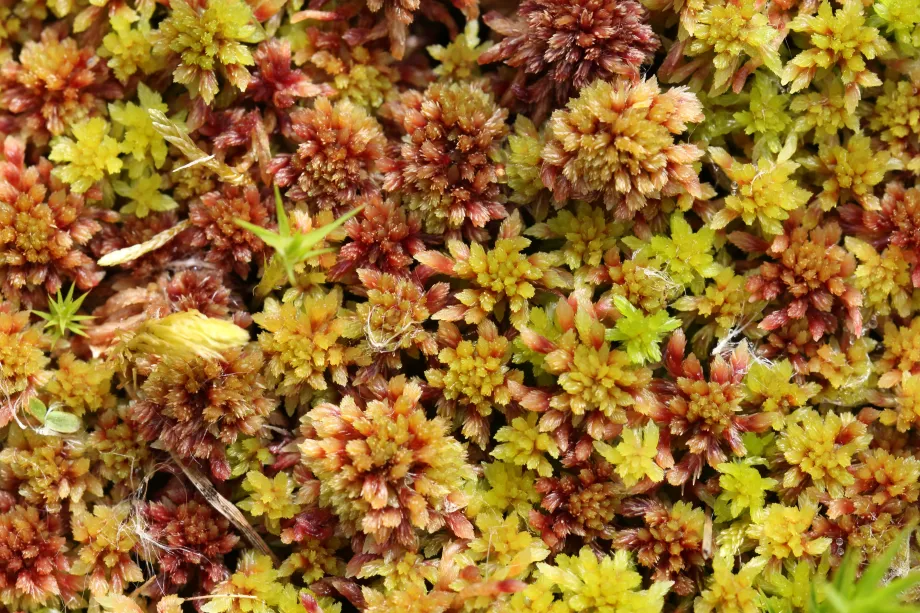
Sphagnum Moss
©️ Margery Thomas

December in Hothfield - Mosses and Lichens

In the darkest weeks of the year the mosses and lichens on the reserve stand out well in low winter light, ranging from dark velvet in the woods to almost neon feathery green in the bogs. The 1951 SSSI citation for Hothfield Heathlands includes twelve un-named Sphagnum moss species. It’s the sphagnum mosses that modify the environment and create the bogs, the most important and one of the largest components of this habitat, so rare in Kent. In his 2021 Flora of Hothfield Heathland botanist Alex Lockton reports that fourteen species of sphagnum moss have been recorded here, although at least one has been lost. His detailed assessment concludes that bog habitat has been well protected by the management. For ‘management’ here read volunteers as well, so a Christmas shout-out to them all.

Sphagnum mosses on the surface absorb and filter over twenty times their weight in water, and slow its flow through the bogs. The wet peat below, half-rotted sphagnum in anaerobic conditions, is a huge carbon store. The plants are non-vascular so have no lignin or real roots to support tall growth. They are usually one cell thick, their complex feathery leaves ‘about as big as a fingernail clipping’ (Hope Jahren: Lab Girl) to maximise water capture and absorption into cells that balloon with moisture or shrink in drought, the small photosynthetic cells in between manufacturing food. With limited nutrients sucked up through the rhizoids and absorbed from rain, fog or snow, the mosses grow only a few centimetres a year, expel hydrogen molecules into the water, increasing the acidity thereby reducing the possibility of competition from larger or faster-growing plants. 


The sphagnums on the reserve form complex communities with other plants, including other mosses such as Aulacomnium palustre, the combinations of bog-moss species varying as weather cycles and ground conditions change. Summarising Lockton, there are still sphagnum species in the drier bog 1 nearest Hothfield village. Bog no 2 with the plastic wood causeway has hummocks of Sphagnum papillosum (papillose bog-moss), often with S. capillifolium (red bog-moss) and lawns of Sphagnum fallax (flat-topped bog-moss). 

The latter is also abundant in bogs 3 and 4, mostly forming lawns in wet parts of the bog and is perhaps the most important plant for the formation of the mire, because it acidifies the water and creates the substrate on which the more specialised bog plants can grow. It is known in only a few sites in East Kent.  Sphagnum squarrosum (spiky bog-moss) and Sphagnum palustre (blunt-leaved bog-moss) prefer the slightly richer water on the edges of bog 4. 

Red bog moss often shows red and is also found in bog 3; both its sub-species capillifolium and rubellum occur in bog 2, the former makes very dense hummocks whereas the latter is more spreading. Sphagnum subnitens (lustrous b-m) is frequent in bogs 2 & 4, where it is the first species to form hummocks rising out of the S. fallax lawn. 

In the more acid parts of bog 2 it is replaced by papillosum and capillifolium. Sphagnum auriculatum (Cow-horn bog-moss) prefers the more acidic water in the centre of bog 3.  The microscopic life teeming within the bog-moss hummocks and swards is another article.  If you’re wondering, clubmosses are an entirely separate family; like mosses they propagate by spores but are vascular.  A few species grew here in the past but are no longer present. 

Red bog-moss. ©️ Vaughn Matthews

Your presence on the reserve is of course welcome all year round. If it’s armchair weather, check out Kent Wildlife Trust’s large online selection of presents for all ages online selection of presents. Or consider giving your time and try volunteering next year try volunteering next year.

To all who care for and about this little patch of amazing mossy engineers of, in Lockton’s words, extraordinary conservation status, from Ian Rickards, Area Manager and Will Glasson, Area Warden our warm thanks and best wishes. 


Wassail. 
Margery Thomas
 

presents wrapped under the tree

Check out our shop range

A lovely collection that would make the perfect gift for friends or family this Christmas.

Whether you're looking something small, something big or just something to show you care, there's a gift here for you.

Shop here