Mini dexter standing under a tree by a lake on a clear sunny day
Jessica Allam

The Dinky Dexters

These little ladies have grazed sites such as Conningbrook lakes, Ashford Warren, Singleton and Holborough Marshes, showcasing their capabilities in grazing a range of habitats. Read on to find out more about their unique personalities.

A portrait image of a mini dexter cow looking directly at the camera. This is cow 008

Cow 008 - The Chill One. Jessica Allam

The 'Chill' One

You’ll usually find 008 relaxing and chewing the cud. Cattle are ruminants, meaning they have a multi-chambered stomach designed to break down tough plant material and extract maximum nutrition. The largest chamber, the rumen, is where fermentation occurs and is the defining feature of ruminant digestion. Ruminants such as cows, goats, and sheep can spend up to eight hours a day chewing the cud — as many as 30,000 chews daily. This process stimulates saliva production, which contains enzymes that aid digestion. Repeated regurgitation and re-chewing breaks down vegetation thoroughly, allowing nutrients to be absorbed efficiently and enabling these animals to gain weight on a plant-based diet alone.
A portrait image of a mini dexter cow looking directly at the camera. This is cow 003

Cow 003 - The Always Late One. Jessica Allam

The 'Always Late' One

You’ll often find this little one in a world of her own, usually the last to catch up with the herd. She’s easily distracted by a tasty-looking branch, a juicy bramble, or—most tempting of all—a lush patch of grass, preferring to stop and snack rather than hurry along. Many people assume these mini Dexter cattle are bulls (male) due to the presence of horns, but they are in fact heifers (female). Cattle use their horns for a variety of purposes, including scratching and grooming, pulling down taller vegetation for themselves or their herd mates to eat, and as a means of defence.
A portrait image of a mini dexter cow looking directly at the camera. This is cow 014

Cow 014 - The Hungry One. Jessica Allam

The 'Hungry' One

Much like humans, 014 enjoys a varied diet and will eat different plants seasonally depending on her nutritional requirements. In the winter cattle will favour protein and calorie heavy foods such as holly, Ivy and gorse - perfect for bulking up for the colder months acting as insulation and energy stores when there is little food around. To put this into perspective, gorse has roughly 17g protein in 100g, compared to 100g of egg which has roughly 12g protein!
A portrait image of a mini dexter cow looking directly at the camera. This is cow 009

Cow 009 - The Curious One. Jessica Allam

The 'Curious' One

Cow 009 loves to investigate her surroundings. Cows have poor depth perception due to having their eyes on either side of their head. This makes it difficult for them to gage how far away you are so will usually stop grazing and look up at you as you walk by. We call this binocular vision as when they look up it allows them to put both pictures from each eye together and gauge depth, just like we do naturally as our eyes are together on the front of our faces. So our cows don't have to worry if you are too close, always keep a minimum of 10 meters distance between you and the cattle.
A portrait image of a mini dexter cow looking directly at the camera. This is cow 007

Cow 007 - The Shy One. Jessica Allam

The 'Shy' One

Like all cows, 007 feels safest with her herd and enjoys the company of her herd mates. If you spot a single cow out on the reserve, there will almost certainly be others nearby, even if you can’t see them. Cows don’t just eat grass; they enjoy a wide range of vegetation and will happily tunnel into dense bramble to reach the tasty leaves within. This is why cattle make such effective “bramble bulldozers.” By opening up dense scrub and breaking u the landscape, they allow light to reach the ground and help increase habitat diversity by allowing the less dominant plants to come through. Compared to roe deer, which can only transport around 28 types of plant seeds, cattle can spread more than 230 species. These seeds are carried in their fur, hooves, and gut, and are re-seeded across the landscape—often with a little homemade fertiliser (aka dung) included.

Find out more about our conservation grazers

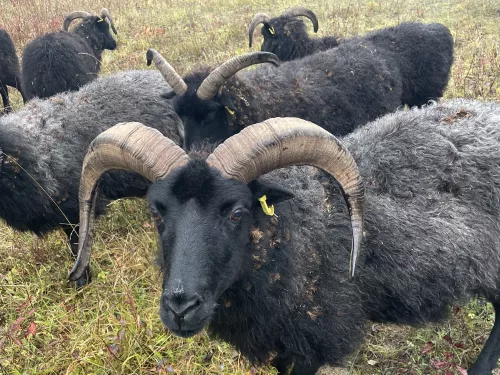
Hebridean sheep close up surrounded by other sheep
Dave Watson

The nomads

Information page

This lovable clan migrate around several reserves throughout the year led by their leader, Skittles.

The ginger glam squad

Information page

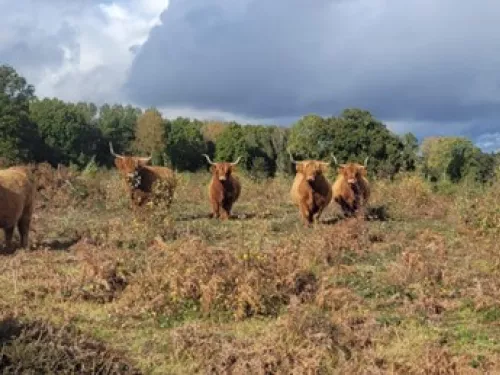
Meet the Highland cows that are part of our crucial Wilder Grazing programme